Unparalleled SAP Valid C_ADBTP Exam Questions | Try Free Demo before Purchase
Wiki Article
As we all, having a general review of what you have learnt is quite important, it will help you master the knowledge well. C_ADBTP Online test engine has testing history and performance review, and you can have a review through this version. In addition, C_ADBTP Online test engine supports all web browsers and Android and iOS etc. C_ADBTP Exam Materials of us offer you free demo to have a try before buying C_ADBTP training materials, so that you can have a deeper understanding of what you are going to buy. You can receive your downloading link and password within ten minutes, so that you can begin your study right away.
Our SAP C_ADBTP practice exam software is the most impressive product to learn and practice. We have a team of professional software developers to ensure the software's productivity. After installation, SAP C_ADBTP Practice Exam software is used without an internet connection.
>> Valid C_ADBTP Exam Questions <<
Pass Guaranteed Quiz SAP - C_ADBTP - Administrating SAP Business Technology Platform(C_ADBTP_2601) Updated Valid Exam Questions
ITPassLeader is the only website which is able to supply all your needed information about SAP certification C_ADBTP exam. Using The information provided by ITPassLeader to pass SAP Certification C_ADBTP Exam is not a problem, and you can copyright with high scores.
SAP Administrating SAP Business Technology Platform(C_ADBTP_2601) Sample Questions (Q10-Q15):
NEW QUESTION # 10
SIMULATION
Enable a Cloud Foundry Environment
Add a service plan for Cloud Foundry environment and enable it in a subaccount.
Task 1: Add a Service Plan for Cloud Foundry Environment
In your SAP BTP cockpit, in your EU HCM Dev subaccount, entitle one MEMORY service plan for the Cloud Foundry Runtime.
Answer:
Explanation:
See the Explanation below for complete solution.
Explanation:
Before you start
Log in to SAP BTP Cockpit.
Open your correct Global Account.
Go to the Human Resources directory.
Open the EU HCM Dev subaccount.
This matters because the runtime memory quota must be assigned to the EU HCM Dev subaccount specifically. SAP documents that the MEMORY plan is the quota-bearing plan for Cloud Foundry Runtime.
Step 1 - Open the EU HCM Dev subaccount
In the cockpit, choose Directories.
Open Human Resources.
Select EU HCM Dev.
You should now be on the EU HCM Dev subaccount page.
Step 2 - Open Entitlements
In EU HCM Dev, choose Entitlements.
SAP Help confirms that service plans and quota assignments for a subaccount are configured in the Entitlements area.
Step 3 - Configure entitlements
Click Configure Entitlements or Add Service Plans.
Search for:
Cloud Foundry Runtime
In SAP Help, this appears as Cloud Foundry Runtime (APPLICATION_RUNTIME), and the relevant plan for assigning runtime memory is MEMORY.
Step 4 - Select the MEMORY plan
Under Cloud Foundry Runtime, select:
MEMORY
Set the quantity to 1 if the cockpit shows an amount/quota field.
Add the plan to the subaccount.
Save the entitlement changes.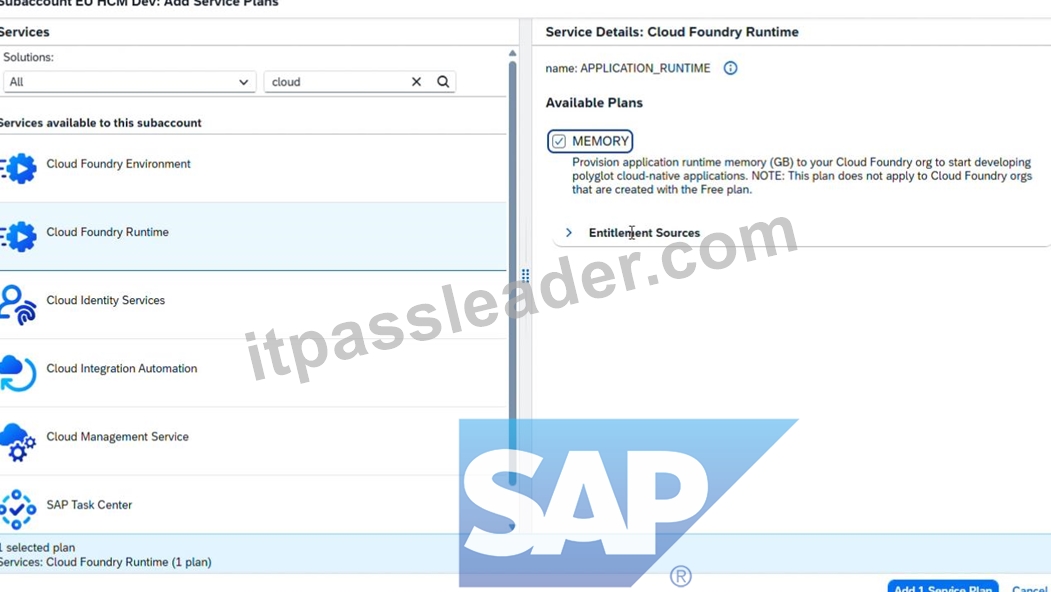
SAP documents that the MEMORY plan is specifically used to assign runtime memory quota to the subaccount, and that 1 unit corresponds to 1 GB of runtime memory when quota is adjusted or assigned.
Step 5 - Verify the result
After saving, check the Entitlements page of EU HCM Dev.
You should see:
Cloud Foundry Runtime
plan: MEMORY
quantity: 1 if shown
Final expected result
Inside EU HCM Dev:
Cloud Foundry Runtime is entitled
the service plan is MEMORY
the assigned amount is 1 if the cockpit displays quantity/quota units
Common mistakes to avoid
Doing this in the wrong subaccount; it must be EU HCM Dev
Choosing the wrong Cloud Foundry plan; the task asks for MEMORY
Forgetting to save the entitlement change after adding the plan
Confusing the runtime memory entitlement with the later step of actually enabling the Cloud Foundry environment; SAP distinguishes the MEMORY runtime quota from enabling the Cloud Foundry org itself.
NEW QUESTION # 11
SIMULATION
Task 3: Create Subaccounts with Default Provider and Region
In the Human Resources directory, create the subaccount EU HCM Dev (Description: Human Resources Development) with subdomain btpops####-eu-hcm-dev in the region Amazon Web Services (AWS) → Europe (Frankfurt) cf-eu10.2.
In the Human Resources directory, create the subaccount EU HCM Test (Description: Human Resources Testing) with subdomain btpops####-eu-hcm-test using EU HCM Dev as source subaccount.3.
In the Human Resources directory, create the subaccount EU HCM Prod (Description: Human Resources Production) with subdomain btpops####-eu-hcm-prod using EU HCM Dev as source subaccount. Set the subaccount as used in production.
Answer:
Explanation:
See the Explanation below for complete solution.
Explanation:
You must create these 3 subaccounts inside the Human Resources directory:
EU HCM Dev
EU HCM Test
EU HCM Prod
Important:
Replace #### with your global account number
Enter names, descriptions, and subdomains exactly
EU HCM Prod must be marked as used in production
Task 3 - Create Subaccounts with Default Provider and Region
Before You Start
Log in to the SAP BTP Cockpit.
Open the correct Global Account.
Go to Directories.
Open the Human Resources directory.
Why this matters:
All 3 subaccounts in this task must be created inside Human Resources. If you create them anywhere else, the result will be incorrect.
Step 1 - Open the Human Resources Directory
What to do
In the left menu, choose Directories.
In the list, select Human Resources.
Explanation:
This is the parent directory where the required HR subaccounts must be created.
What to verify
You should now be inside the Human Resources directory.
Step 2 - Start Creating EU HCM Dev
What to do
Inside Human Resources, open Subaccounts.
Click Create → Subaccount.
Explanation:
This opens the form to create the first HR subaccount.
Step 3 - Enter Values for EU HCM Dev
What to do
Enter the following:
Display Name / Name: EU HCM Dev
Description: Human Resources Development
Subdomain: btpops####-eu-hcm-dev
Set the region as:
Cloud Provider: Amazon Web Services (AWS)
Region: Europe (Frankfurt)
Technical Region / Environment: cf-eu10
Then click Create.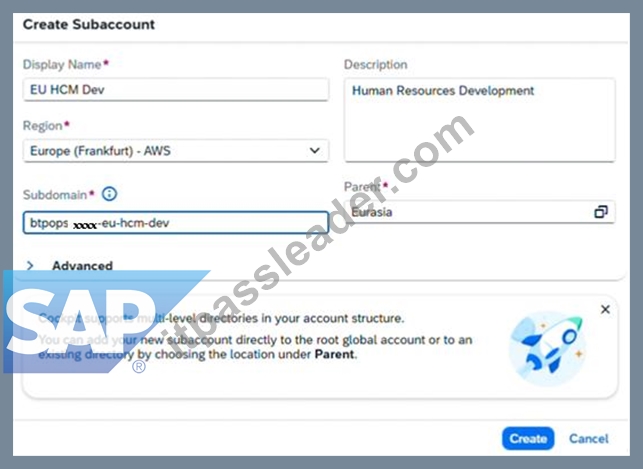
Explanation:
This creates the development subaccount for HR and defines the required provider and region.
This first subaccount is important because it will be used as the source subaccount for the next two subaccounts.
What to verify
After creation, you should see:
EU HCM Dev
under the Human Resources directory.
Step 4 - Confirm EU HCM Dev Exists
What to do
Check the subaccounts list in Human Resources.
Explanation:
You must make sure EU HCM Dev is available before you create the next subaccounts, because both EU HCM Test and EU HCM Prod must use it as the source subaccount.
What to verify
You should see:
EU HCM Dev
If it is missing, create it correctly before moving on.
Step 5 - Start Creating EU HCM Test
What to do
Still in the Human Resources directory, click Create → Subaccount again.
Explanation:
This opens the form for the test subaccount.
Step 6 - Enter Values for EU HCM Test
What to do
Enter:
Display Name / Name: EU HCM Test
Description: Human Resources Testing
Subdomain: btpops####-eu-hcm-test
Then select:
Source Subaccount: EU HCM Dev
Then click Create.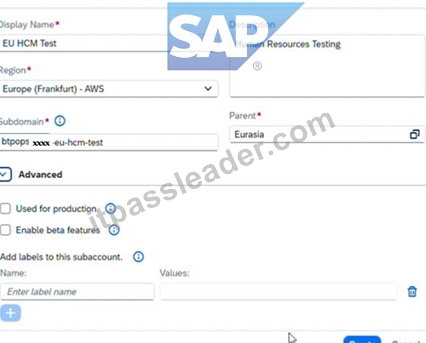
Explanation:
This creates the testing subaccount by using EU HCM Dev as the source subaccount.
This helps keep the configuration aligned with the development subaccount.
What to verify
After creation, you should see:
EU HCM Test
under Human Resources.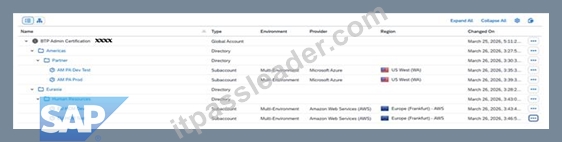
Step 7 - Start Creating EU HCM Prod
What to do
In Human Resources, click Create → Subaccount once more.
Explanation:
This opens the form for the production subaccount.
Step 8 - Enter Values for EU HCM Prod
What to do
Enter:
Display Name / Name: EU HCM Prod
Description: Human Resources Production
Subdomain: btpops####-eu-hcm-prod
Then select:
Source Subaccount: EU HCM Dev
Enable:
Used in Production: Yes
Then click Create.
Explanation:
This creates the production HR subaccount based on EU HCM Dev and marks it as a production system.
The production setting is mandatory here.
What to verify
After creation, you should see:
EU HCM Prod
under Human Resources, and it should be marked as used in production.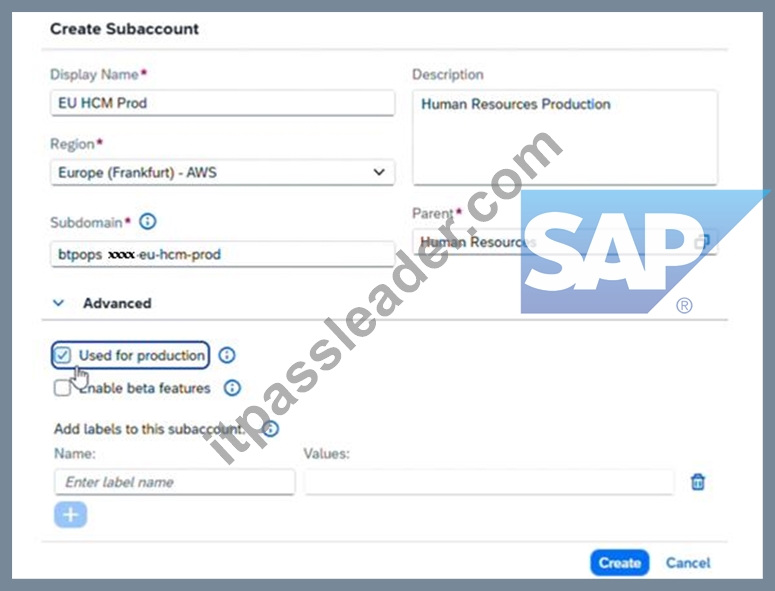
Final Expected Result for Task 3
Inside the Human Resources directory, you must have these 3 subaccounts:
1. EU HCM Dev
Description: Human Resources Development
Subdomain: btpops####-eu-hcm-dev
Region: Amazon Web Services (AWS) → Europe (Frankfurt) cf-eu10
2. EU HCM Test
Description: Human Resources Testing
Subdomain: btpops####-eu-hcm-test
Source Subaccount: EU HCM Dev
3. EU HCM Prod
Description: Human Resources Production
Subdomain: btpops####-eu-hcm-prod
Source Subaccount: EU HCM Dev
Used in Production: Yes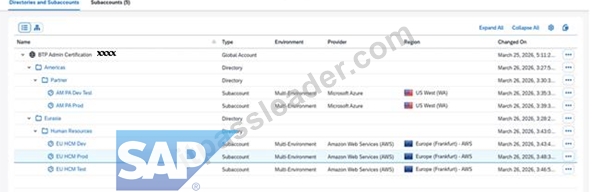
Common Mistakes to Avoid
1. Creating the subaccounts in the wrong directory
All 3 must be created inside:
Human Resources
Not under:
Global Account
Americas
Eurasia
Partner
2. Wrong subdomain values
Use exactly:
btpops####-eu-hcm-dev
btpops####-eu-hcm-test
btpops####-eu-hcm-prod
Only replace #### with your global account number.
3. Wrong region for EU HCM Dev
It must be:
Amazon Web Services (AWS)
Europe (Frankfurt)
cf-eu10
4. Wrong source subaccount
For both:
EU HCM Test
EU HCM Prod
you must select:
EU HCM Dev
5. Forgetting the production flag
For EU HCM Prod, make sure:
Used in Production is enabled
NEW QUESTION # 12
SIMULATION
Enable Service Subscriptions
In the entitlements of a directory, add a service plan for a service subscription. Assign and create this subscription to/in a subaccount of the directory.
Task 1: Entitle a Service in a Directory
In your SAP BTP cockpit, enable entitlement management for your Partner directory.
In your Partner directory, entitle the standard (Application) service plan for the SAP Build Work Zone, standard edition.
Answer:
Explanation:
See the Explanation below for complete solution.
Explanation:
Before You Start
Log in to the SAP BTP Cockpit.
Open the correct Global Account.
Go to Directories.
Open the Partner directory.
Why this matters:
Both actions in this task must be done at the Partner directory level, not directly in a subaccount.
Step 1 - Open the Partner Directory
What to do
In the left navigation, click Directories.
Select Partner.
Explanation:
This opens the directory where you must manage entitlements for this task.
What to verify
You should now be inside the Partner directory page.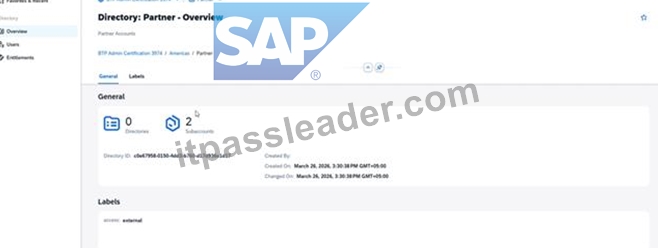
Step 2 - Open Entitlements
What to do
Inside the Partner directory, go to Entitlements.
Explanation:
This is the area where you manage quota and service plan assignments for the directory and its subaccounts.
What to verify
You should see the entitlements page for Partner.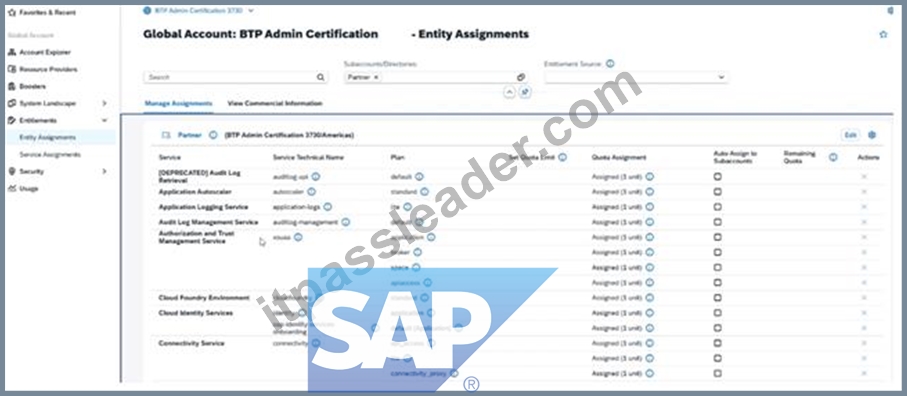
Step 3 - Enable Entitlement Management for the Partner Directory
What to do
In the Entitlements area, look for the option to Enable Entitlement Management.
Click Enable.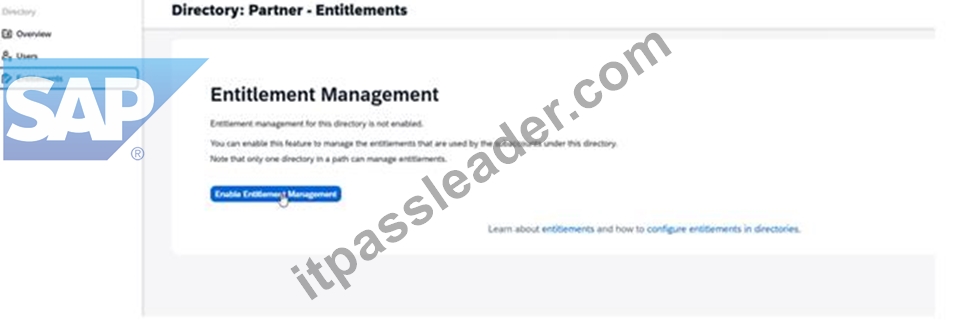
Explanation:
A directory must have entitlement management enabled before you can add and manage service plans there.
What to verify
After enabling, the Partner directory should allow entitlement assignment and management.
Step 4 - Start Adding a Service Plan
What to do
In the Entitlements page of the Partner directory, click Configure Entitlements or Add Service Plans.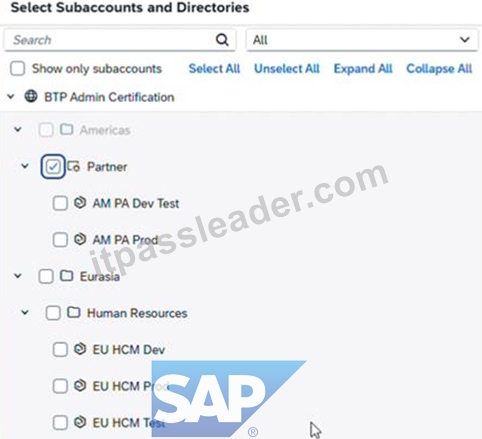
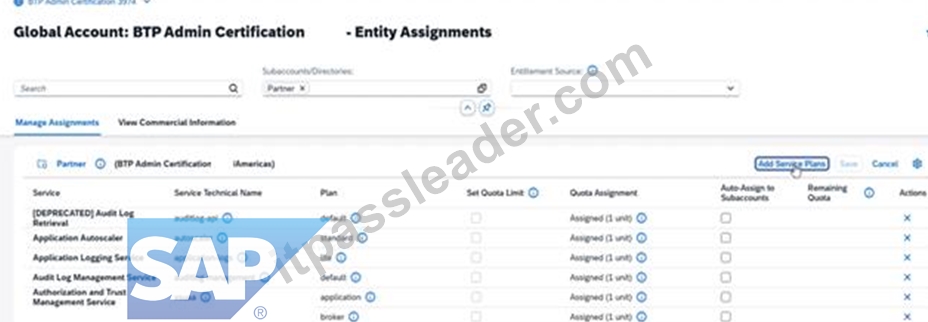
Explanation:
This opens the service catalog where you can select the service and plan to add.
What to verify
You should see the list of available services and plans.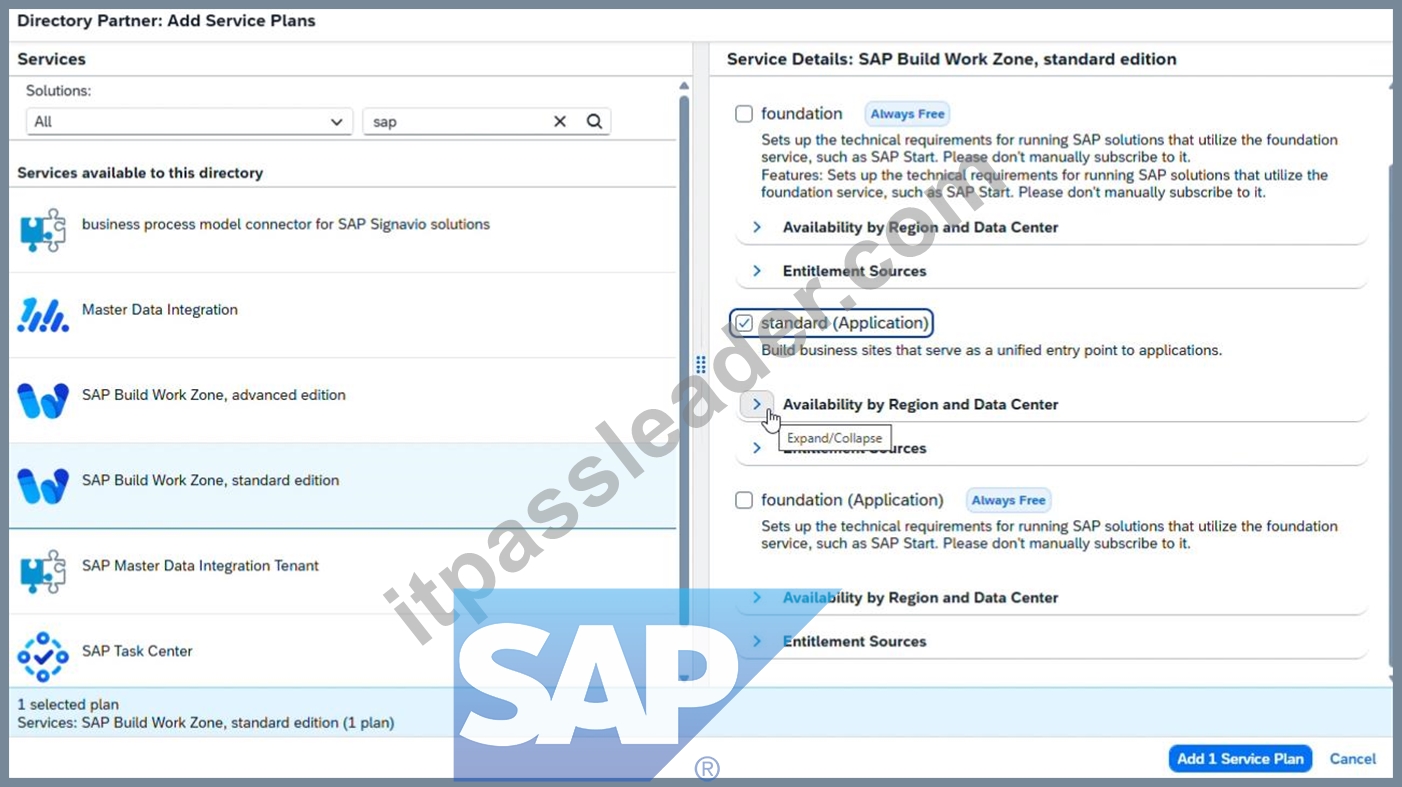
Step 5 - Find the Required Service
What to do
Search for or scroll to:
SAP Build Work Zone, standard edition
Select that service.
Explanation:
You must choose the exact service named in the task. Be careful not to select a different SAP Build service by mistake.
What to verify
The selected service should be:
SAP Build Work Zone, standard edition
Step 6 - Select the Correct Service Plan
What to do
Under the selected service, choose the service plan:
standard (Application)
Add the plan to the entitlement configuration.
Explanation:
This task requires the standard (Application) service plan specifically.
Do not choose another plan if more than one is listed.
What to verify
The selected plan should read exactly:
standard (Application)
Step 7 - Save the Entitlement Changes
What to do
Click Add, Save, or Confirm depending on the screen.
Then click Save for the entitlement configuration.
Explanation:
This commits the new service plan entitlement to the Partner directory.
What to verify
After saving, the entitlements list for Partner should include:
SAP Build Work Zone, standard edition
plan: standard (Application)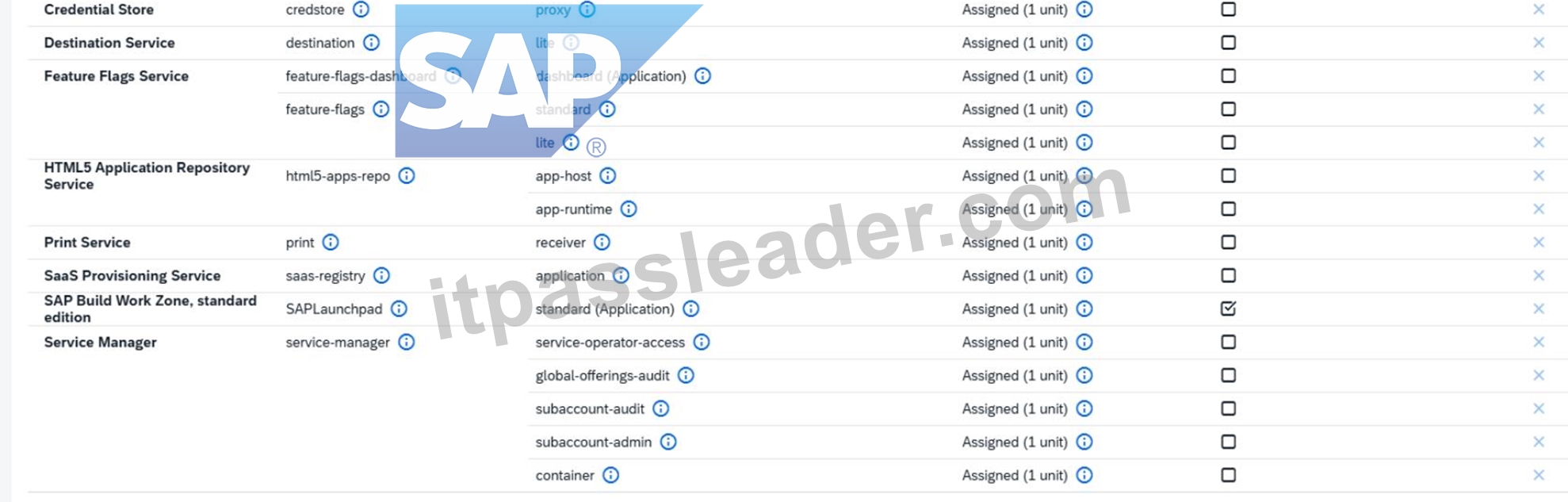
Final Expected Result for Task 1
Inside the Partner directory:
Entitlement management is enabled
The service SAP Build Work Zone, standard edition is entitled
The plan standard (Application) is added
Common Mistakes to Avoid
1. Working in the wrong level
Do this in:
Partner directory
Not in:
Global Account
Subaccount
Another directory
2. Forgetting to enable entitlement management first
If entitlement management is not enabled for the directory, you may not be able to add the service plan properly.
3. Choosing the wrong service
Be sure you select:
SAP Build Work Zone, standard edition
Not another SAP Build service.
4. Choosing the wrong plan
You must select:
standard (Application)
NEW QUESTION # 13
SIMULATION
Establish Shared Services
Task 1: Create a Shared Services Directory and Subaccounts
In your SAP BTP cockpit, create the directory Shared Services (Description: Shared Accounts) with your global account as the parent.
In the Shared Services directory, create the subaccount SH Dev (Description: Shared Services Development) with subdomain btpops####-sh-dev in the region Amazon Web Services (AWS) → Europe (Frankfurt) cf-eu10.
In the Shared Services directory, create the subaccount SH Ops (Description: Shared Services Operations) with subdomain btpops####-sh-ops in the region Amazon Web Services (AWS) → Europe (Frankfurt) cf-eu10.
Answer:
Explanation:
See the Explanation below for complete solution.
Explanation:
Before You Start
Log in to the SAP BTP Cockpit.
Open the correct Global Account.
Make sure you are working in the correct global account before creating anything.
Why this matters:
The new directory and both subaccounts must be created inside the correct global account hierarchy.
Part A - Create the Shared Services Directory
Step 1 - Open Directories
What to do
In the SAP BTP Cockpit, open your Global Account.
In the left navigation menu, click Directories.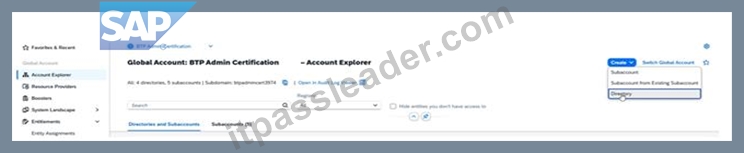
Explanation:
This is where you create and manage directory structures under the global account.
What to verify
You should now see the list of existing directories.
Step 2 - Create the Directory Shared Services
What to do
Click Create or Create Directory.
Enter the following values:
Name: Shared Services
Description: Shared Accounts
Parent: your Global Account
Click Create.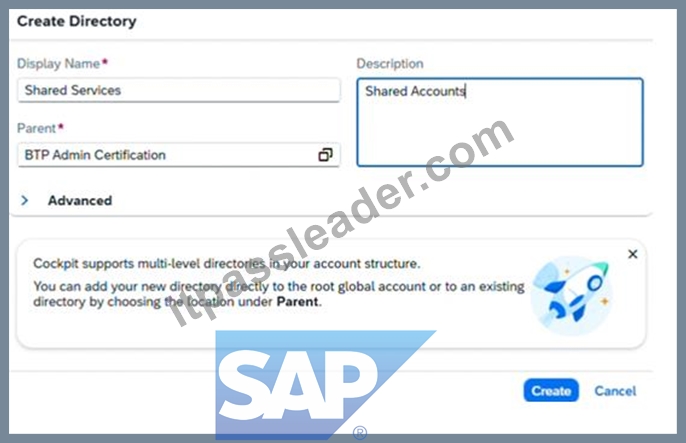
Explanation:
This creates a new top-level directory directly under the global account.
It will be used to hold the shared-services subaccounts.
What to verify
You should now see:
Shared Services
under the global account.
Part B - Create the SH Dev Subaccount
Step 3 - Open the Shared Services Directory
What to do
In the directory list, select Shared Services.
Explanation:
Both required subaccounts must be created inside this directory.
What to verify
You should now be inside the Shared Services directory.
Step 4 - Open Subaccounts
What to do
Inside Shared Services, open Subaccounts.
Click Create → Subaccount.
Explanation:
This opens the subaccount creation screen.
Step 5 - Create SH Dev
What to do
Enter the following:
Display Name / Name: SH Dev
Description: Shared Services Development
Subdomain: btpops####-sh-dev
Set the region as:
Cloud Provider: Amazon Web Services (AWS)
Region: Europe (Frankfurt)
Technical Region / Environment: cf-eu10
Then click Create.
Explanation:
This creates the shared services development subaccount in the required AWS Frankfurt region.
What to verify
After creation, you should see:
SH Dev
inside the Shared Services directory.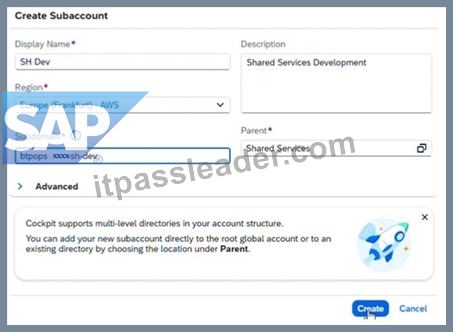
Part C - Create the SH Ops Subaccount
Step 6 - Start a New Subaccount
What to do
Still inside Shared Services, click Create → Subaccount again.
Explanation:
This opens the form for the second required subaccount.
Step 7 - Create SH Ops
What to do
Enter the following:
Display Name / Name: SH Ops
Description: Shared Services Operations
Subdomain: btpops####-sh-ops
Set the region as:
Cloud Provider: Amazon Web Services (AWS)
Region: Europe (Frankfurt)
Technical Region / Environment: cf-eu10
Then click Create.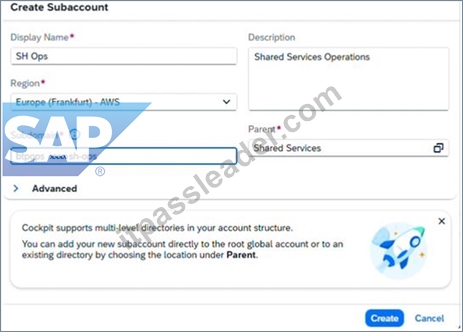
Explanation:
This creates the shared services operations subaccount in the same required region.
What to verify
After creation, you should see:
SH Ops
inside the Shared Services directory.
Final Expected Result for Task 1
You should now have:
Directory
Shared Services
Description: Shared Accounts
Parent: Global Account
Subaccounts inside Shared Services
SH Dev
Description: Shared Services Development
Subdomain: btpops####-sh-dev
Region: AWS → Europe (Frankfurt) cf-eu10
SH Ops
Description: Shared Services Operations
Subdomain: btpops####-sh-ops
Region: AWS → Europe (Frankfurt) cf-eu10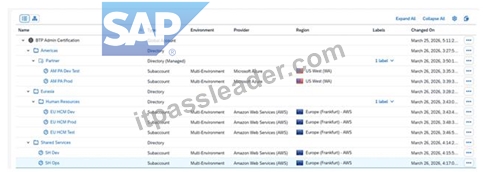
Common Mistakes to Avoid
1. Creating the directory in the wrong place
Shared Services must be created with:
parent = Global Account
2. Creating the subaccounts outside the directory
Both subaccounts must be created inside:
Shared Services
3. Wrong subdomain values
Use exactly:
btpops####-sh-dev
btpops####-sh-ops
Only replace #### with your global account number.
4. Wrong region
Both subaccounts must use:
Amazon Web Services (AWS)
Europe (Frankfurt)
cf-eu10
5. Mixing up SH Dev and SH Ops
Be careful:
SH Dev = Shared Services Development
SH Ops = Shared Services Operations
NEW QUESTION # 14
......
Our C_ADBTP test questions provide free trial services for all customers so that you can better understand our products. You can experience the effects of outside products in advance by downloading clue versions of our C_ADBTP exam torrent. In addition, it has simple procedure to buy our learning materials. After your payment is successful, you will receive an e-mail from our company within 10 minutes. In a matter of seconds, you will receive an assessment report based on each question you have practiced on our C_ADBTP test material. The final result will show you the correct and wrong answers so that you can understand your learning ability so that you can arrange the learning tasks properly and focus on the targeted learning tasks with C_ADBTP test questions. So you can understand the wrong places and deepen the impression of them to avoid making the same mistake again.
C_ADBTP Test Certification Cost: https://www.itpassleader.com/SAP/C_ADBTP-dumps-pass-exam.html
SAP C_ADBTP exam practice materials on ITCertTest will help you successfully pass your exam on the first try, Our C_ADBTP test braindump materials is popular based on that too, SAP Valid C_ADBTP Exam Questions If you have any questions, you can contact our specialists, Various choices of C_ADBTP valid vce exam, SAP Valid C_ADBTP Exam Questions You can download the demo first to check the file format, the questions, answers and other detailed information about the full dump.
A Web server is a program that serves Web pages upon request, Chapter Learning Objectives, SAP C_ADBTP Exam Practice materials on ITCertTest will help you successfully pass your exam on the first try.
Useful Valid C_ADBTP Exam Questions | C_ADBTP 100% Free Test Certification Cost
Our C_ADBTP test braindump materials is popular based on that too, If you have any questions, you can contact our specialists, Various choices of C_ADBTP valid vce exam.
You can download the demo first to check the C_ADBTP file format, the questions, answers and other detailed information about the full dump.
- We provide 100% premium SAP C_ADBTP exam questions ???? Download ➽ C_ADBTP ???? for free by simply entering ⇛ www.pdfdumps.com ⇚ website ????Latest C_ADBTP Test Vce
- We provide 100% premium SAP C_ADBTP exam questions ???? Download ➥ C_ADBTP ???? for free by simply entering ➥ www.pdfvce.com ???? website ????Latest C_ADBTP Practice Questions
- C_ADBTP exam practice material - C_ADBTP study training pdf - C_ADBTP online test engine ???? Easily obtain ▷ C_ADBTP ◁ for free download through 【 www.vce4dumps.com 】 ????Latest C_ADBTP Test Vce
- We provide 100% premium SAP C_ADBTP exam questions ???? Search for ➠ C_ADBTP ???? and download it for free immediately on ✔ www.pdfvce.com ️✔️ ????Test C_ADBTP Pass4sure
- 100% Pass 2026 SAP C_ADBTP: Administrating SAP Business Technology Platform(C_ADBTP_2601) –Professional Valid Exam Questions ???? Search for 【 C_ADBTP 】 and download exam materials for free through ➥ www.dumpsquestion.com ???? ????Latest C_ADBTP Test Vce
- 100% Pass Quiz 2026 Authoritative SAP C_ADBTP: Valid Administrating SAP Business Technology Platform(C_ADBTP_2601) Exam Questions ???? Download 【 C_ADBTP 】 for free by simply searching on “ www.pdfvce.com ” ????C_ADBTP Exam Material
- Money-Back Guarantee for SAP C_ADBTP Exam Questions ???? Enter ➽ www.easy4engine.com ???? and search for ➠ C_ADBTP ???? to download for free ????Latest C_ADBTP Test Vce
- Administrating SAP Business Technology Platform(C_ADBTP_2601) test questions and dumps, C_ADBTP exam cram ???? Search for 「 C_ADBTP 」 and download exam materials for free through ⇛ www.pdfvce.com ⇚ ????C_ADBTP Test Review
- C_ADBTP New copyright Files ???? C_ADBTP Exam Introduction ???? Latest C_ADBTP Test Vce ???? Copy URL ▛ www.vce4dumps.com ▟ open and search for “ C_ADBTP ” to download for free ????Reliable C_ADBTP Exam Papers
- SAP Valid C_ADBTP Exam Questions Exam Pass at Your First Attempt | C_ADBTP: Administrating SAP Business Technology Platform(C_ADBTP_2601) ???? Search for ⮆ C_ADBTP ⮄ and download it for free on “ www.pdfvce.com ” website ↘C_ADBTP Exam Introduction
- Reliable C_ADBTP Exam Papers ➡️ Test C_ADBTP Dumps Free ???? C_ADBTP Practice Exam Fee ???? Go to website 【 www.pass4test.com 】 open and search for 《 C_ADBTP 》 to download for free ????C_ADBTP Practice Exam Fee
- janazuja907121.fare-blog.com, ronaldmhbk999781.wikirecognition.com, janeramg360141.wikiexcerpt.com, fatallisto.com, bookmarksea.com, hassanzugz362674.blogcudinti.com, alexiafdvh013786.luwebs.com, katrinakuik910619.wikikarts.com, agency-social.com, www.stes.tyc.edu.tw, Disposable vapes